Planetary imaging · Step 6 of 7
The rotation limit
In a sentence: Jupiter turns once in under 10 hours: a video that runs too long smears its detail. One to two minutes, at most.
Planets turn
Jupiter is the fastest-turning planet: one rotation in 9 h 56 min. At a long focal length, the Great Red Spot moves a pixel in barely a minute. If the video runs too long, the stack mixes different positions and the detail smears. Saturn turns almost as fast, but it has less detail that shows; Mars turns slowly, like the Earth.
| Planet | At 2,000 mm | At 4,000 mm |
|---|---|---|
| Jupiter | 2 to 3 minutes | 1 to 1.5 minutes |
| Saturn | 4 to 5 minutes | 2 to 3 minutes |
| Mars | 5 minutes or more | 3 to 4 minutes |
The simulator in step 2 works it out for your own gear. With WinJUPOS you can “derotate” several videos and add them together, but that’s processing.
A real example
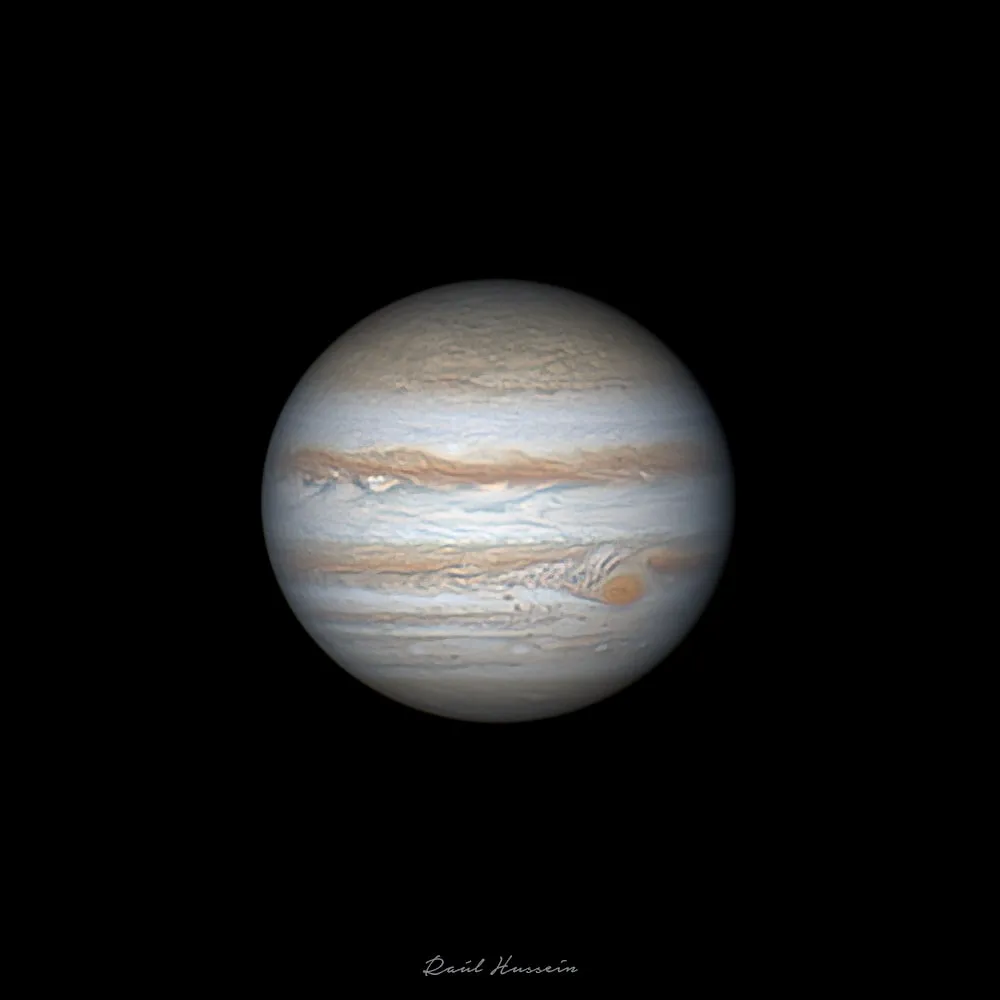
This Jupiter by Raúl Hussein was shot with a 235 mm Schmidt-Cassegrain, a 2× Barlow (4,700 mm of focal length) and an ASI462MC camera: nine videos of 6,480 frames each, stacked and derotated with WinJUPOS.