Monday, August 2, 2027 · in the morning
Total Solar Eclipse of August 2, 2027
The Moon’s shadow sweeps across the Strait of Gibraltar and southern Spain in mid-morning: in Tarifa, day turns to night for 4 min 41 s; in Ceuta, for 4 min 51 s. The rest of Spain gets a partial eclipse, and across most of Andalusia the Moon will cover more than 95% of the Sun.
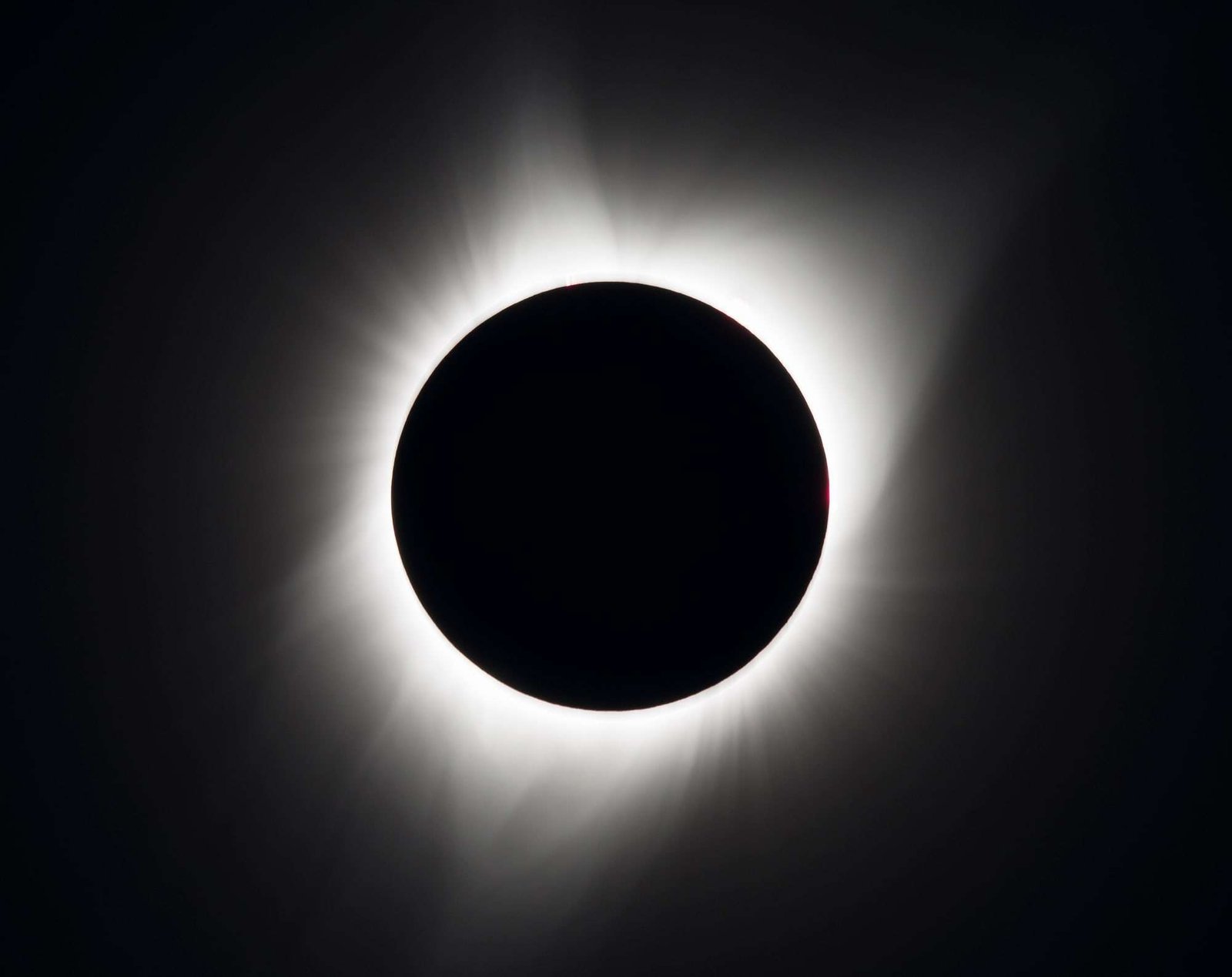

The eclipse from your location
Calculating…
The path of totality
Inside the path, the eclipse is total: the closer you are to the center line, the longer it lasts. Outside, it’s partial, and the farther away you are, the less of the Sun the Moon covers.
- Totality
- Center line: the longest totality
- Your location, if it’s on the map
What time in each city
Local time at each place (summer time in mainland Spain, Ceuta and Melilla: CEST, UTC+2). It starts when the Moon first touches the Sun and ends when it leaves it; in the cities with a total eclipse, maximum is the middle of totality.
| City | What you’ll see | Starts | Totality | Maximum | Ends | Sun altitude |
|---|---|---|---|---|---|---|
| Tetouan (Morocco time) | Total: 4 min 55 s | 08:40 | 09:45:00–09:49:55 | 09:47:27 | 11:01 | 38° |
| Tangier (Morocco time) | Total: 4 min 54 s | 08:40 | 09:44:34–09:49:28 | 09:47:01 | 11:00 | 38° |
| Ceuta | Total: 4 min 51 s | 09:40 | 10:45:12–10:50:03 | 10:47:36 | 12:01 | 38° |
| Tarifa | Total: 4 min 41 s | 09:40 | 10:44:59–10:49:41 | 10:47:19 | 12:00 | 38° |
| Melilla | Total: 4 min 40 s | 09:42 | 10:48:03–10:52:42 | 10:50:22 | 12:05 | 41° |
| Algeciras | Total: 4 min 29 s | 09:40 | 10:45:18–10:49:48 | 10:47:33 | 12:00 | 38° |
| Gibraltar | Total: 4 min 29 s | 09:41 | 10:45:25–10:49:55 | 10:47:40 | 12:00 | 38° |
| La Línea de la Concepción | Total: 4 min 26 s | 09:41 | 10:45:28–10:49:54 | 10:47:41 | 12:00 | 38° |
| Barbate | Total: 4 min 18 s | 09:40 | 10:44:53–10:49:11 | 10:47:02 | 12:00 | 38° |
| Vejer de la Frontera | Total: 4 min 08 s | 09:40 | 10:44:56–10:49:04 | 10:47:00 | 11:59 | 38° |
| Conil de la Frontera | Total: 4 min 02 s | 09:40 | 10:44:51–10:48:53 | 10:46:51 | 11:59 | 38° |
| Estepona | Total: 3 min 39 s | 09:41 | 10:46:11–10:49:50 | 10:48:00 | 12:01 | 39° |
| Chiclana de la Frontera | Total: 3 min 29 s | 09:40 | 10:45:07–10:48:36 | 10:46:50 | 11:59 | 38° |
| Marbella | Total: 3 min 18 s | 09:41 | 10:46:41–10:49:59 | 10:48:20 | 12:01 | 39° |
| San Fernando | Total: 3 min 17 s | 09:40 | 10:45:10–10:48:27 | 10:46:48 | 11:59 | 38° |
| Fuengirola | Total: 3 min 11 s | 09:41 | 10:47:04–10:50:15 | 10:48:39 | 12:02 | 39° |
| Cadiz | Total: 2 min 54 s | 09:40 | 10:45:17–10:48:11 | 10:46:44 | 11:59 | 37° |
| Torremolinos | Total: 2 min 42 s | 09:41 | 10:47:29–10:50:11 | 10:48:50 | 12:02 | 39° |
| El Puerto de Santa María | Total: 2 min 28 s | 09:40 | 10:45:35–10:48:03 | 10:46:48 | 11:59 | 37° |
| Rota | Total: 2 min 14 s | 09:40 | 10:45:35–10:47:48 | 10:46:41 | 11:59 | 37° |
| Malaga | Total: 1 min 50 s | 09:42 | 10:48:02–10:49:52 | 10:48:58 | 12:02 | 39° |
| Motril | Total: 1 min 43 s | 09:42 | 10:49:12–10:50:54 | 10:50:02 | 12:03 | 40° |
| Jerez de la Frontera | Total: 1 min 35 s | 09:40 | 10:46:10–10:47:46 | 10:46:58 | 11:59 | 38° |
| Nerja | Total: 1 min 28 s | 09:42 | 10:48:53–10:50:21 | 10:49:37 | 12:03 | 40° |
| Ronda | Total: 1 min 17 s | 09:41 | 10:47:27–10:48:44 | 10:48:05 | 12:01 | 39° |
| Vélez-Málaga | Total: 1 min 01 s | 09:42 | 10:48:51–10:49:52 | 10:49:21 | 12:02 | 40° |
| Sanlúcar de Barrameda | Partial: 99.9% | 09:40 | — | 10:46:45 | 11:59 | 37° |
| Almeria | Partial: 99.9% | 09:43 | — | 10:51:23 | 12:05 | 41° |
| Antequera | Partial: 99.5% | 09:42 | — | 10:48:53 | 12:02 | 39° |
| Granada | Partial: 99.1% | 09:42 | — | 10:50:04 | 12:03 | 40° |
| Huelva | Partial: 98.5% | 09:40 | — | 10:46:18 | 11:58 | 37° |
| Seville | Partial: 98.2% | 09:41 | — | 10:47:24 | 11:59 | 38° |
| Jaén | Partial: 97% | 09:43 | — | 10:50:03 | 12:03 | 40° |
| Cordoba | Partial: 96.5% | 09:42 | — | 10:48:57 | 12:01 | 39° |
| Murcia | Partial: 96.2% | 09:45 | — | 10:53:22 | 12:07 | 43° |
| Lisbon (Portugal time) | Partial: 92.4% | 08:40 | — | 09:44:44 | 10:54 | 35° |
| Valencia | Partial: 90.1% | 09:46 | — | 10:54:43 | 12:08 | 43° |
| Palma de Mallorca | Partial: 89.1% | 09:49 | — | 10:58:38 | 12:13 | 46° |
| Madrid | Partial: 86.2% | 09:45 | — | 10:51:08 | 12:02 | 40° |
| Barcelona | Partial: 81.5% | 09:50 | — | 10:58:24 | 12:11 | 45° |
| Zaragoza | Partial: 80.9% | 09:48 | — | 10:54:47 | 12:06 | 42° |
| Santa Cruz de Tenerife (Canary Islands time) | Partial: 79.3% | 08:32 | — | 09:33:44 | 10:41 | 26° |
| Las Palmas (Canary Islands time) | Partial: 77.3% | 08:33 | — | 09:34:20 | 10:42 | 27° |
| Bilbao | Partial: 74.2% | 09:48 | — | 10:53:10 | 12:02 | 40° |
| A Coruña | Partial: 73.2% | 09:45 | — | 10:47:56 | 11:54 | 35° |
Calculated with Astronomy Engine (MIT) for the center of each city, at sea level. Times may be off by a few seconds; very close to the edge of the path, the exact duration depends on the mountains along the Moon’s limb. Map: coastline and borders from Natural Earth.
What a total eclipse is like
For a little over an hour, the Moon takes a bigger and bigger bite out of the Sun and you barely notice: the light slowly fades and turns strange, shadows get sharper and it cools down. In the last few seconds everything happens at once: the shadow rushes in from the western horizon, the Sun shrinks to a few beads of light along the Moon’s edge (Baily’s beads) and one last flash, the diamond ring. Then the corona appears, the Sun’s atmosphere, which you never get to see any other way; Venus and the brightest stars come out, and there’s a sunset all around the horizon.
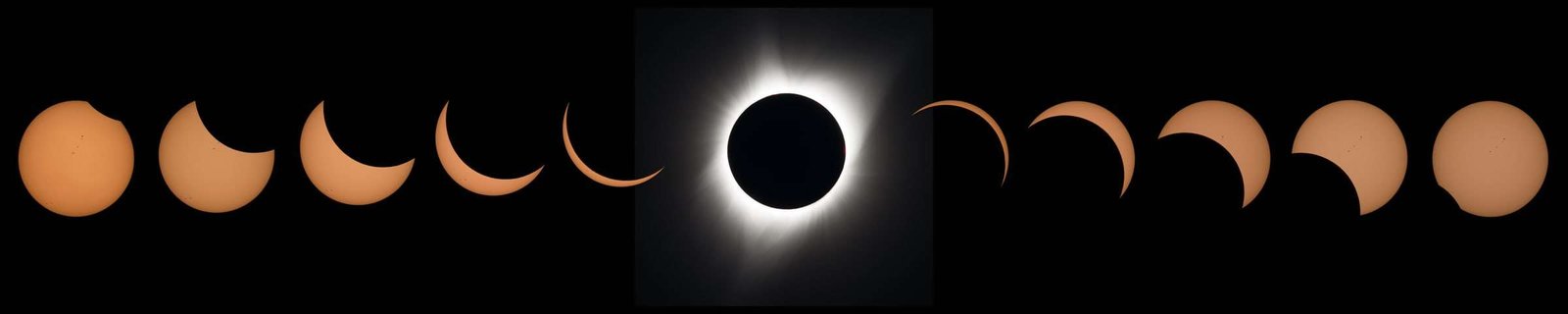

Outside the path there’s no totality, however much of the Sun the Moon covers: with 98% covered, as in Seville, it’s still daytime, you can’t see the corona and you can’t look without eclipse glasses. That’s why it’s worth getting into the path, even if it’s just a few miles.
How to watch it safely
- Certified eclipse glasses (ISO 12312-2), from a store you trust. Sunglasses, X-ray film and smoked glass don’t protect your eyes.
- Never through binoculars, a telescope or a camera viewfinder without a solar filter on the front. The filter always goes on the front, never on the eyepiece.
- Only during totality, and only inside the path, can you look without glasses. As soon as the first flash of sunlight returns, glasses back on.
Before you rely on these times. They’re estimates, and “Your eclipse” is an experimental tool, still in development. The software, your phone or your computer can fail for reasons beyond our control: the battery, power saving, a system update, silent mode or the device’s clock. Have a plan B: the times written down on paper and a separate alarm, and check the figures against official sources. Protecting your eyes and your gear is your responsibility. More in our legal notice (in Spanish).
How to photograph it
The most important thing: practice first. You can photograph the Sun through a filter any day, so you get to August 2 with your focus, framing and sequence already tested.
- The partial phases, with a sheet of ND 5.0 solar filter film on the front of the lens, at ISO 100 and around 1/500 s at f/8 (it depends on your gear: test it).
- Totality, without the filter: a bracketed series from 1/1000 s to 1 s. The short ones bring out the pink prominences on the edge; the long ones, the faintest streamers of the corona. Blended together like an HDR, you get the whole corona.
- Focal length: the Sun is half a degree across, and the corona two or three times that. With 400–800 mm on an APS-C camera you fill the frame; with a wide-angle lens, you capture the landscape and the shadow on the horizon.
- Let the camera do the shooting. With an intervalometer or an automated sequence, the camera works while you watch. It’s only a few minutes, and you don’t get a second chance.
- Get a heads-up. Taking the filter off a few seconds before the diamond ring, and not earlier, is the hardest part: the spoken countdown in the Astrolarius app calls it to the second (in Spanish for now; English is coming before the eclipse).
Spain’s eclipses: 2026, 2027 and 2028
Spain is in the middle of a run that won’t come back for a long time: the total eclipse of August 12, 2026, at sunset, in the north; this one on August 2, 2027, in mid-morning, in the south; and the annular eclipse of January 26, 2028, with the "ring of fire" setting in the west over Andalusia and the east coast. All the upcoming eclipses, meteor showers and planet oppositions, in astronomical events 2027–2028.
Frequently asked questions
Where will the August 2, 2027 eclipse be total in Spain?
In a path about 240 km (150 miles) wide that crosses the Strait of Gibraltar: the south of the province of Cadiz (Tarifa, Algeciras, Barbate, Conil, Cadiz, Jerez), the Malaga coast (from Estepona to Nerja), Motril, Ceuta and Melilla. Outside the path, the eclipse is partial across all of Spain: in Seville the Moon covers 98.2% of the Sun; in Madrid, 86.2%; and in Barcelona, 81.5%.
What time is the eclipse on August 2, 2027?
In the morning. In Tarifa, the Moon starts covering the Sun at 09:40, totality runs from 10:44:59 to 10:49:41 and the eclipse ends at 12:00 (local time, CEST). Across the rest of Spain the times are very similar: maximum between 10:46 and 10:59.
How long does totality last?
It depends on how close you are to the center of the path: 4 min 51 s in Ceuta, 4 min 41 s in Tarifa, 2 min 54 s in Cadiz and 1 min 50 s in Malaga. It’s one of the longest eclipses of the century: in Egypt, near Luxor, it goes past 6 minutes.
How do you watch an eclipse without hurting your eyes?
With certified eclipse glasses (ISO 12312-2), and you keep them on as long as any sliver of the Sun is showing. Sunglasses don’t work, and neither does X-ray film or smoked glass. Never look through binoculars, a telescope or a camera without a solar filter on the front. Only during totality, inside the path, can you look without glasses, and you have to put them back on as soon as the first flash of sunlight appears.
How do you photograph a total eclipse?
With a solar filter on the front of the lens (ND 5.0 film) during the partial phases, and without it only during totality. For the corona, a bracketed series from 1/1000 s to 1 s at low ISO: each exposure captures a different part, from the pink prominences on the edge to the faintest streamers. Focus and test the day before, with the same filter, and let an automated sequence do the shooting during totality, so you get to watch it.
What’s the weather like in southern Spain in early August?
It’s usually dry and sunny, but on the Strait of Gibraltar coast the levante wind and low morning clouds can spoil the day. Have a backup spot inland, inside the path, and keep an eye on the forecast in the days before.