What isn’t in the box · Step 1 of 5
No night without these
In a sentence: Four things that send you home with nothing if they’re missing: something to see with, something to join camera to tube, something to power it and something to tighten it.
A red headlamp, a real one
Your eyes take 20 to 30 minutes to adapt to the dark, and lose it in a second to white light. That’s why red is used: at the same intensity, red spoils night vision far less.
A headlamp rather than a flashlight isn’t fussiness: it leaves both hands for the screw you’re holding. And of the ten-dollar ones, check two things before you pay: that the red comes on first (plenty start in white and blind you and everyone next to you) and that it’s low power or dimmable, because 300 lumens of red blinds just as well.
TipPut your phone in red mode at minimum brightness, and remember to turn off the raise-to-wake screen. Nearly every astronomy app has a red mode; Astrolarius does too.
Whatever joins your camera to your tube
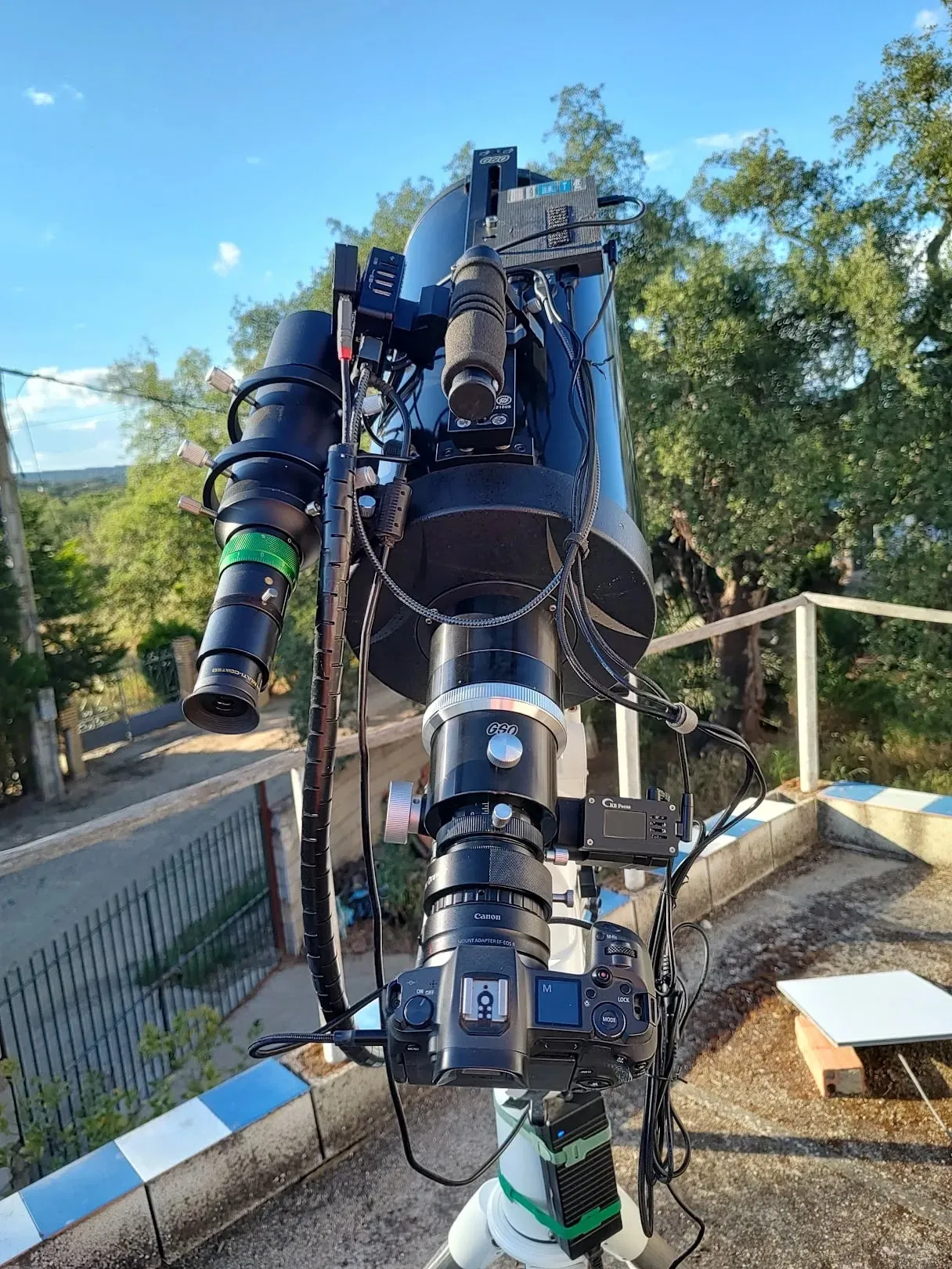
This is the one that ruins the most nights, and the one you’re least warned about. A DSLR doesn’t screw onto a telescope: you need two pieces that almost never come with anything.
The T-ring (or T2 ring), which is specific to your camera mount: the Canon EF one won’t do for Nikon F or Sony E. And the adapter that takes that T-ring to your tube’s thread or focuser: sometimes a 1.25″ or 2″ nosepiece, sometimes an M42 or M48 thread, sometimes the flattener’s own.
If you use a flattener or a reducer there’s a third matter, with a guide of its own: the exact distance between reducer and sensor, the backfocus. The spacers that takes are things you have to buy too.
Heads-upBefore you buy anything, write the whole chain down on paper, from camera to tube, piece by piece and thread by thread. Almost every wrong purchase comes from assuming it’ll just fit. And there’s one case that catches a lot of people: with a DSLR, some Newtonians won’t reach focus, and you need to move the mirror up or use a shorter tube; other tubes want the exact opposite, an extension. Ask first.
Power for the camera: the dummy battery
A DSLR taking long exposures all night goes through two or three batteries. And every change means opening the camera in the dark, in the cold, and often moving it: goodbye framing, and if you rotate it, goodbye to that night’s flats.
The fix hardly anyone knows about when they start is the dummy battery (a DC coupler): a piece shaped like your battery that goes into its slot and comes out through the door with a cable. That cable goes to wall power or to your big 12 V battery. The camera never runs out and you don’t have to open it all night.
They exist for almost every camera and cost $25 to $45. Watch the voltage: the camera runs at about 7.5 or 8 volts, not 12. Buy the kit with its converter (12 V, USB or AC) and never plug the bare coupler into the big battery.
The mask focuses once; the motor, all night
The Bahtinov mask is the quickest, safest way to focus, it costs little, and it should be in your bag from day one. But it solves the start of the night.
Because focus doesn’t hold still: as it cools, the tube contracts and pulls the mirror toward the sensor. We tell the whole story in why focus runs away from you by midnight. With a mask, either you get up to refocus every hour or the second half of the night comes out worse than the first.
So the moment you want to leave the gear alone and go to bed, a motorized focuser stops being a luxury. It isn’t a bag accessory: it mounts on the tube and it’s gear, but the decision belongs with these. One condition: it only helps if you have something that runs the autofocus (N.I.N.A., the ASIAIR, Ekos). The motor on its own focuses nothing.
TipShooting with a telephoto lens instead of a tube? Then there’s nowhere to clamp a normal focuser, but there is a toothed-belt system that goes around the lens’s focus ring, with its own pinion. They run about $100, well under the price of a brand-name EAF, and they work with N.I.N.A. and the rest. Clamp the lens properly by its rings: the belt turns the ring, and if the lens shifts, your framing shifts.
What’s always missing at three in the morning
- Spare memory cards: two hundred RAW frames fill more than you’d think, and planetary video, far more.
- Allen wrenches to fit the screws on your rings and your dovetail, in the backpack pocket, not in the workshop.
- Something to take flats with before you tear down: a flat panel, a white T-shirt pulled tight with a soft light behind it, or the dawn sky. Pack up without them and that night’s dust and focus are gone for good, and another day’s won’t do.
- Lens wipes and a blower for the optics. Never your T-shirt.
- A roll of duct tape: it holds a loose cable, covers an LED you can’t switch off and saves a broken dew shield.
- Thin gloves: in the cold your fingers stop working, and small screws get dropped.
- A thermos of coffee or tea. At three in the morning it isn’t a treat: it’s what keeps you awake for the last run and what gives you your hands back.
- Spare batteries for the headlamp and the shutter release, which always die early.
- A UV/IR cut filter, if your camera doesn’t have one inside. Plenty of color cameras ship with just a protective window: check the specs, because without that filter a refractor gives you bloated stars.
- A mat or a light-colored tarp under the tripod: that’s where what you drop stays, instead of vanishing into the grass.