What isn’t in the box · Step 3 of 5
Dew, cold and the rain you weren’t expecting
In a sentence: Heater straps for everything with glass in it, something to regulate them with, and something to throw over the gear when it starts to rain.
Straps for everything with glass in it
The dew heater strap (what the dew guide calls a heater or a band) is a strip that wraps around the outside of the tube, near the lens, and keeps it just above air temperature. With that, it doesn’t fog up.
And here comes what hardly anyone says out loud: it isn’t one strap, it’s several. The main tube, yes, but also:
- The finder or the guide scope. It usually fogs up before the main tube, and when it does you lose guiding without knowing why. It’s the one most people forget.
- The guide camera’s lens, if you guide with a small telephoto.
- The corrector plate on a Schmidt-Cassegrain or a Maksutov: the glass that closes the tube sits right at the front and fogs over completely. On a Newtonian what fogs is the secondary, which is inside.
- The DSLR, if you shoot with a lens: a small strap around the lens, not the body.
Heads-upStraps are sold by the tube’s outside diameter, not by its aperture. Measure across the tube with a tape, or work out the circumference, before ordering: a strap that doesn’t go all the way around is no use.
A controller, not a switch
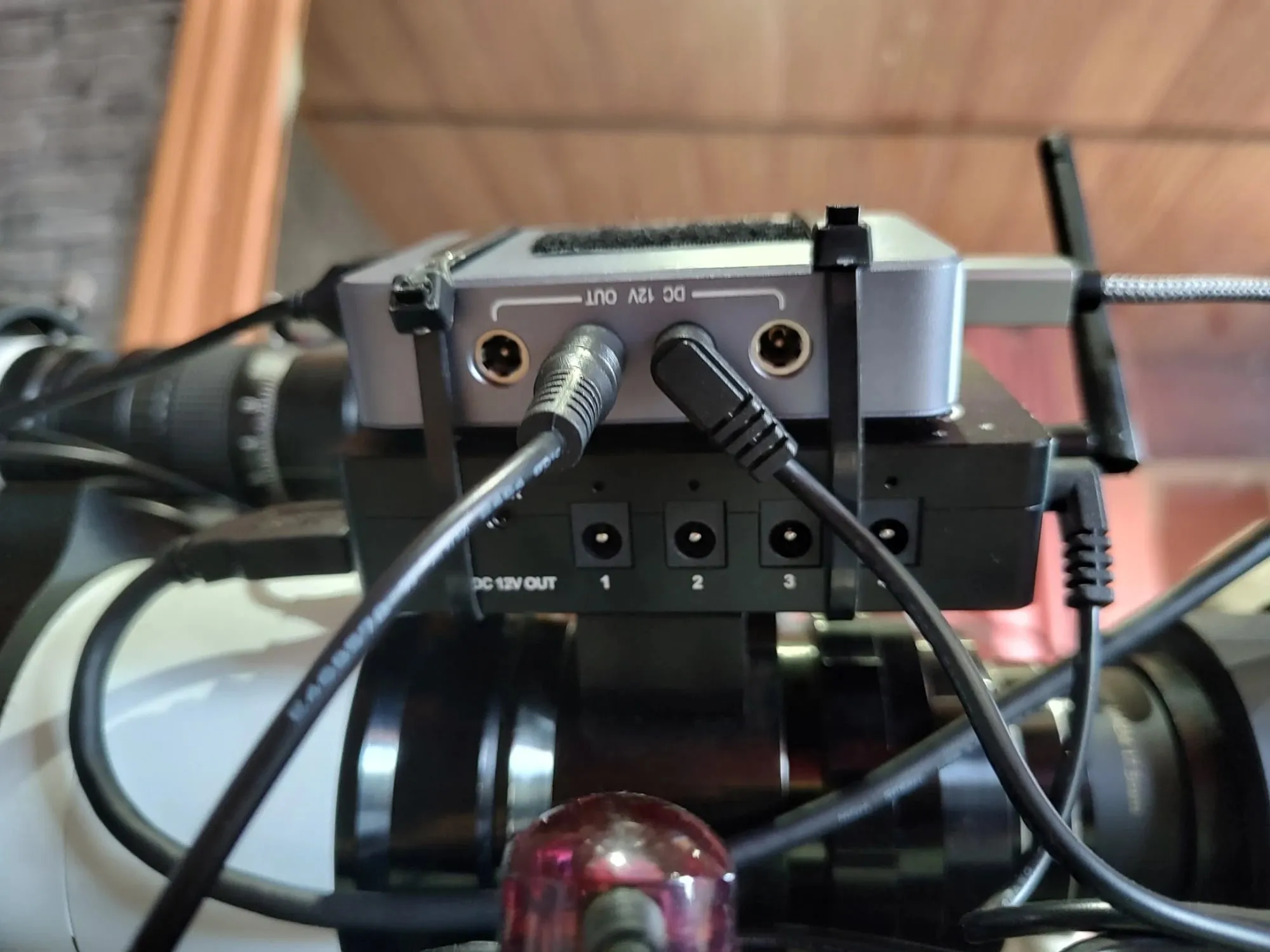
Running the straps flat out all night uses twice the power and puts warm air in front of the tube, which makes the images worse. What people use is a controller with regulation (PWM): four outputs, a knob per output and, on the good ones, a temperature and humidity sensor that does it for you.
The power you need isn’t a guess: in the dew guide it comes out of the manufacturers’ catalogs and lands at 2 to 3.5 watts per 100 mm of tube circumference. A refractor 90 mm across the outside has about 283 mm of circumference, so 6 to 10 watts is enough. Far less than people think.
TipBefore buying straps, try a long dew shield: it blocks part of the cold sky and sometimes that’s enough, especially on refractors. And if you do fit a strap, the shield means you need fewer watts. A ten-dollar thermo-hygrometer tells you whether you’re in trouble tonight.
When the weather turns
Gear that’s set up can’t be torn down in two minutes, and forecasts get it wrong. A waterproof cover — anything from a telescope-specific one to a big heavy-duty trash bag and a couple of clips — lets you cover the whole thing and wait out the shower.
What really matters is not the tube getting wet: it’s the camera, the controller and the connections. If you have to choose what to cover first, start there.
And if you’re out in the field, think about yourself too: a chair and more warm clothes than you think. Out there it’s always colder than the forecast said.