Backfocus, demystified · Step 3 of 5
What each part adds
In a sentence: The camera already uses up part of it; the filter wheel, the off-axis guider and the spacers make up the rest. And the filter, if you have one, raises the number you have to hit.
The camera already uses up part of it
The sensor isn’t at the camera’s front face: it sits a few millimeters inside. That depth is the camera’s backfocus, and it’s the first thing to subtract.
| Part | What it adds | Where to look it up |
|---|---|---|
| DSLR or mirrorless, with its T-ring | Exactly 55 mm | T-rings are made for exactly that, whatever the mount |
| Cooled ZWO camera (“Pro”), with its adapter | 17.5 mm | ZWO’s spec sheet |
| Any other astronomy camera | Whatever its spec sheet says | Look for “back focus” or “sensor distance” |
| Filter wheel, off-axis guider (OAG), tilt adjuster | Its thickness | Each part’s spec sheet |
| Spacers | What’s printed on the ring | And measure it (step 4) |
| Filter between the reducer and the camera | Takes up no room: it raises the target by a third of its thickness | A 2 mm filter raises the target by 0.67 mm |
On a mirrorless camera, the T-ring for its mount is already longer, to get you to 55 mm. If you use a DSLR-to-mirrorless adapter (EF to RF, say), the whole stack also adds up to 55.
With a mirrorless camera
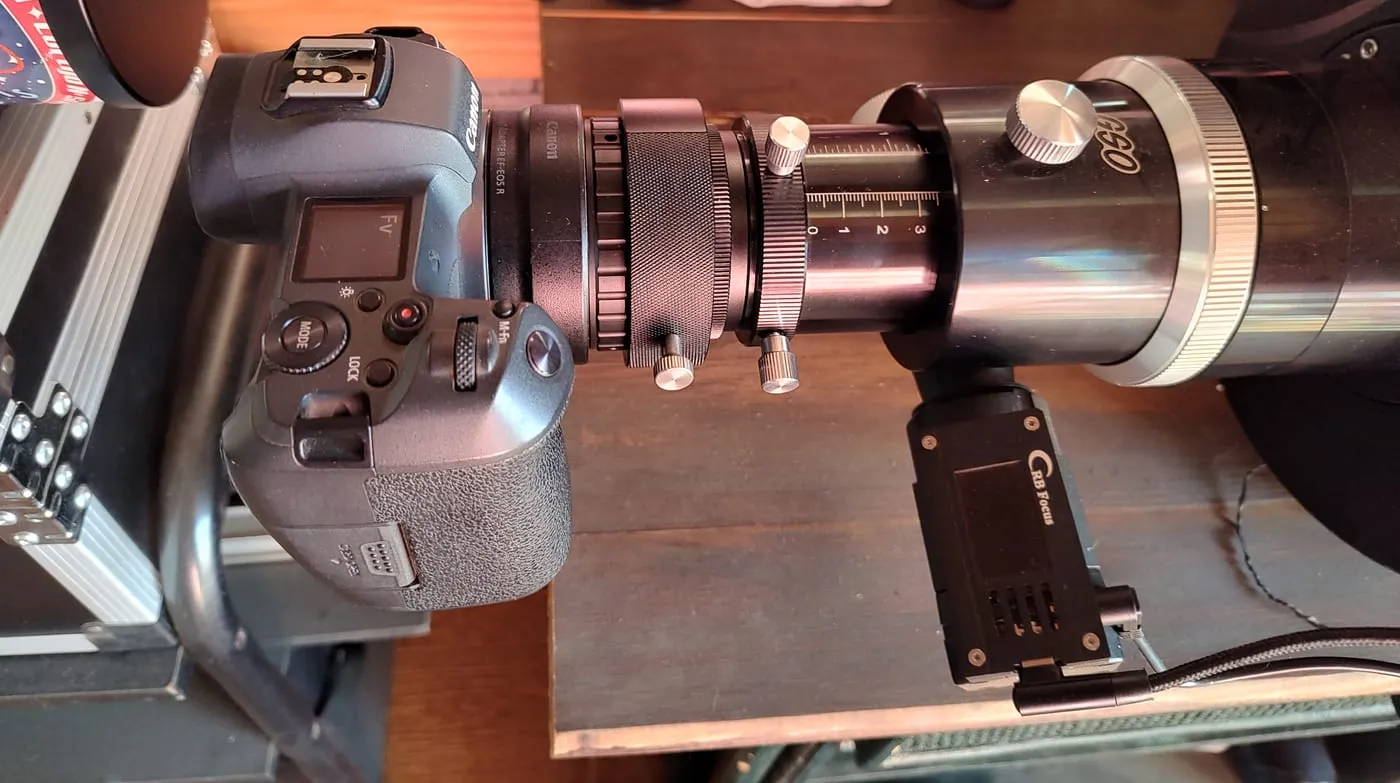
My Canon EOS R has its mount very close to the sensor (20 mm). With the EF-to-RF adapter and a DSLR T-ring, the stack adds up to 55 mm again, just like a DSLR: what counts is the total, not each piece.
The filter counts too
A glass filter in the light path pushes focus back by about a third of its thickness: 1 mm gives you 0.33 mm; 2 mm, 0.67; 3 mm, 1 mm. It only counts if it sits between the reducer and the sensor (in a wheel, or in a filter drawer behind the reducer). A filter threaded in front of the reducer changes nothing.
Watch the sign: because focus moves back, the sensor has to sit farther away, so the filter raises the number you have to hit and you need more spacers, not fewer. Switch to a thicker filter and you may have to add half a millimeter.
Two examples with my reducer
On my 600 mm scope the reducer asks for 58 mm:
- With a DSLR: the T-ring gives 55. You’re 3 mm short: one 3 mm spacer and you’re done.
- With a cooled ZWO and a 20 mm filter wheel with 2 mm filters: the filter raises the target to 58 + 0.67 = 58.67 mm, so 58.67 − 17.5 − 20 = 21.2 mm of spacers. For example, 20 + 1 + 0.3.
TipYou don’t have to do the math by hand: the calculator at the end of the guide does it and tells you which spacers to use.