The sky
The Moon
In a sentence: The Moon lights the sky like a giant streetlight; with narrowband filters it gets in the way far less, and in broadband the answer is almost always to wait.
The essentials
Three things matter: how lit it is, whether it’s above the horizon, and how close it is to your object. A full Moon 120° away from the object is less trouble than a half Moon 30° away. With a 3–7 nm dual-band filter you can shoot an emission nebula under a lot of Moon, especially in Hα; OIII suffers more. Galaxies and clusters are better on moonless nights.
Three things to look at
How much Moon there is (its phase), whether it’s above the horizon, and how far it is from the object. A waning Moon that rises at four in the morning leaves almost the whole night free; a half Moon high up and close to the object can ruin all of it.
Moonlight is reflected sunlight: it has every color in it. A narrowband filter only passes a few wavelengths, which is why it removes almost all of it; in broadband, by contrast, the Moon brightens the background like a city sky.
What to shoot under a Moon
Emission nebulae with a dual-band filter (the narrower the better) and, if you have a mono camera, Hα. Leave galaxies, dusty clusters and reflection nebulae for the moonless nights.
And if the Moon won’t let you, photograph the Moon
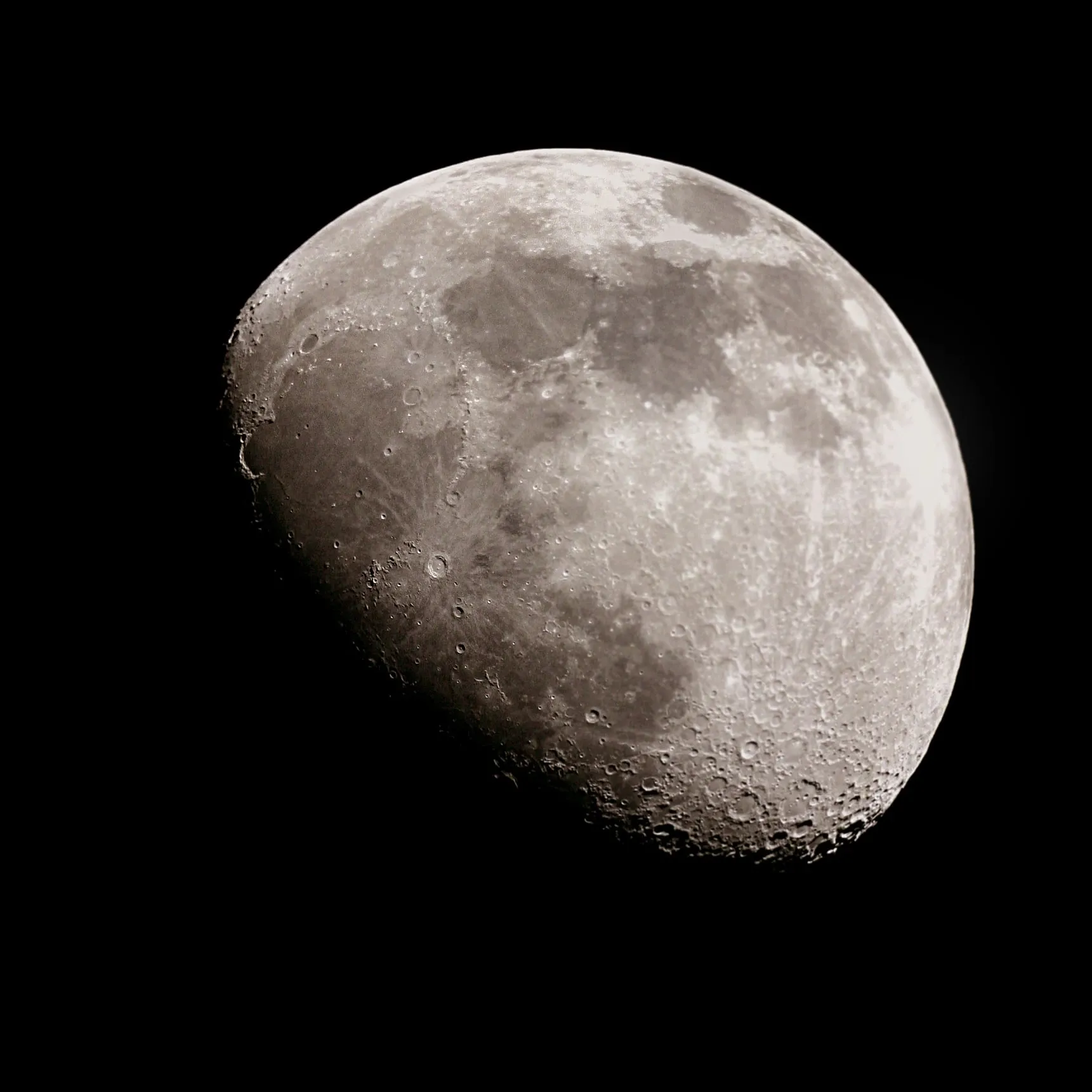
The Moon ruins deep sky, but it’s the most rewarding object in the sky: you can see it from the city, it doesn’t ask for hours of frames, and it comes out well with almost any gear. It’s the best way to practice focusing and exposure before going after a nebula.
Don’t wait for the full Moon: with the Sun straight on there are no shadows and it comes out flat, like a white disk. The beauty is at the terminator, the line between lunar day and night, where long shadows pick out the craters and the mountains. The best days run from the crescent to first quarter and a few days after, and the same on the waning side.
The gear: more focal length, more Moon
The Moon is half a degree across, and its size on the sensor depends only on focal length: roughly the focal length divided by 110. At 300 mm it covers 2.7 mm, a small disk in the middle of the frame; at 1,000 mm, about 9 mm, and past about 1,700 mm it no longer fits whole on an APS-C sensor (you’d have to shoot a mosaic).
With a DSLR, a solid tripod and a 200 to 600 mm telephoto are enough: the exposures are so short that you don’t need tracking. With a telescope, a motorized mount at lunar rate saves you reframing every minute. A shutter release or the 2-second timer and the electronic shutter (or mirror lock-up) keep the vibration out.
The exposure: the Moon is daylight
It’s a landscape lit by the Sun, so you expose it like daylight. A starting point, the “Looney 11” rule: full Moon, f/11 and a shutter speed of 1 over the ISO (at ISO 100, 1/125 s). At the quarters, two stops more light (1/30 s); on a thin crescent, three or four.
Watch the histogram, not the screen: the lit edge mustn’t blow out. With a telescope, very short exposures are better (1/250 s or less) with the ISO pushed up, to freeze the turbulence. Shoot RAW and focus in live view with the magnifier all the way up, on the edge of the terminator.
To take it a step further
Take a lot of frames in a row (20 to 100) and stack them: the noise drops and detail comes back. With a planetary camera you record a few seconds of video and stack the best frames with AutoStakkert!, then sharpen with RegiStax’s wavelets or with Siril.
Two more ideas: earthshine (the dark part of a thin crescent, lit by the Earth), which takes a second or two and blows out the crescent on purpose; and the Moon rising over the horizon behind a building or a mountain, with a telephoto and from a long way off.
An example: the Moon at first quarter
An APS-C DSLR with a 400 mm on a tripod: the Moon covers about 3.6 mm of the 15.7 mm short side. The rule gives, for the quarter, 1/30 s at ISO 100 and f/11; opening up to f/8 and going to ISO 200 gains two stops, which leaves 1/125 s, shorter and sharper. Thirty frames in a burst, stacked in Siril, and a crop: out comes a Moon with the terminator craters well defined.