Emission nebula · Dorado
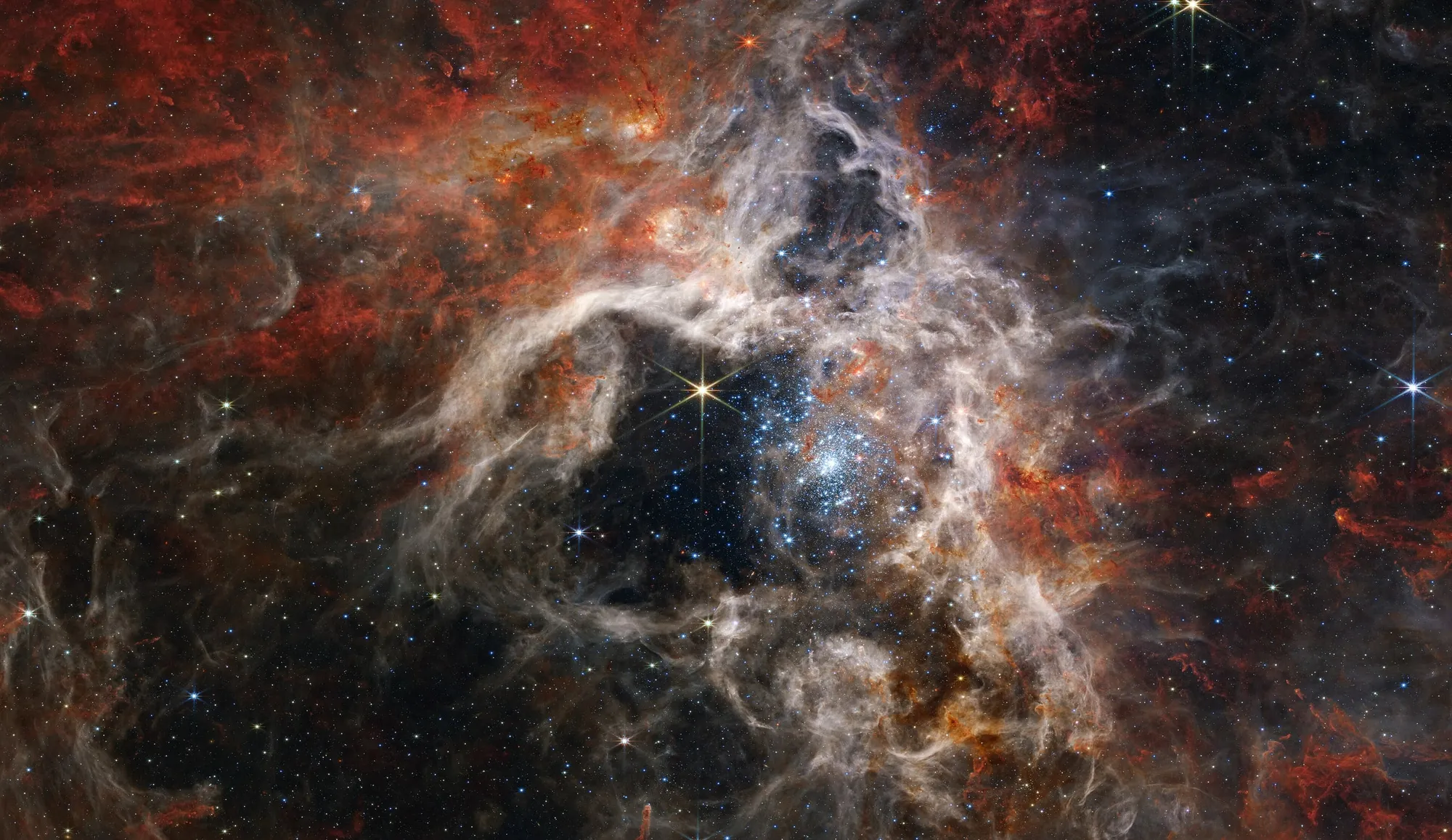
NGC 2070: Tarantula Nebula
the Tarantula Nebula (NGC 2070) is an emission nebula in the constellation of Dorado, 16′ across and magnitude 7.3.
- Catalogs
- NGC 2070 · C 103
- Type
- Emission nebula
- Constellation
- Dorado
- Position (J2000)
- RA 5h 38m · Dec −69° 06′
- Size
- 16′
- Magnitude
- 7.3
- Highest it gets at 40° N
- Never rises
What it emits, and which filter suits it
Its light is concentrated in a few emission lines: Hα (strong), OIII (moderate), SII (faint).
With a color camera
With a color camera, a dual-band filter (Hα + OIII) is what helps most, especially with the Moon up or under a Bortle 5 or worse sky: it lets Hα through, which is nearly all of its light, and blocks the rest. Under a dark sky with no Moon, a UV/IR cut also works, with more natural colors and more time on target.
With a mono camera
Narrowband filters, one at a time: Hα and OIII for an HOO palette; its SII is faint.
When to photograph it
From 40° N it never rises: it stays below the horizon all year. You would have to travel south to photograph it.
- January: good season
- February: good season
- March
- April
- May
- June
- July
- August
- September
- October: good season
- November: good season
- December: good season
What focal length frames it well
With an APS-C sensor of 23.5 × 15.7 mm (the one in an ASI2600 or a DSLR) and three typical focal lengths:
The scale is in arcseconds per pixel, with 3.76 µm pixels.
More objects for the same season
- B 33: Horsehead Nebula · dark nebula, in Orion
- M 42: Orion Nebula · emission nebula with a star cluster, in Orion
- NGC 2024: Flame Nebula · emission nebula, in Orion
- Sh2-264: Lambda Orionis Ring · emission nebula, in Orion
- ESO 056-115: Large Magellanic Cloud · galaxy, in Dorado
- M 35 · open cluster, in Gemini
- M 45: The Pleiades · open cluster, in Taurus
- IC 342: Hidden Galaxy · galaxy, in Camelopardalis