Galaxy · Triangulum
M 33: Triangulum Galaxy
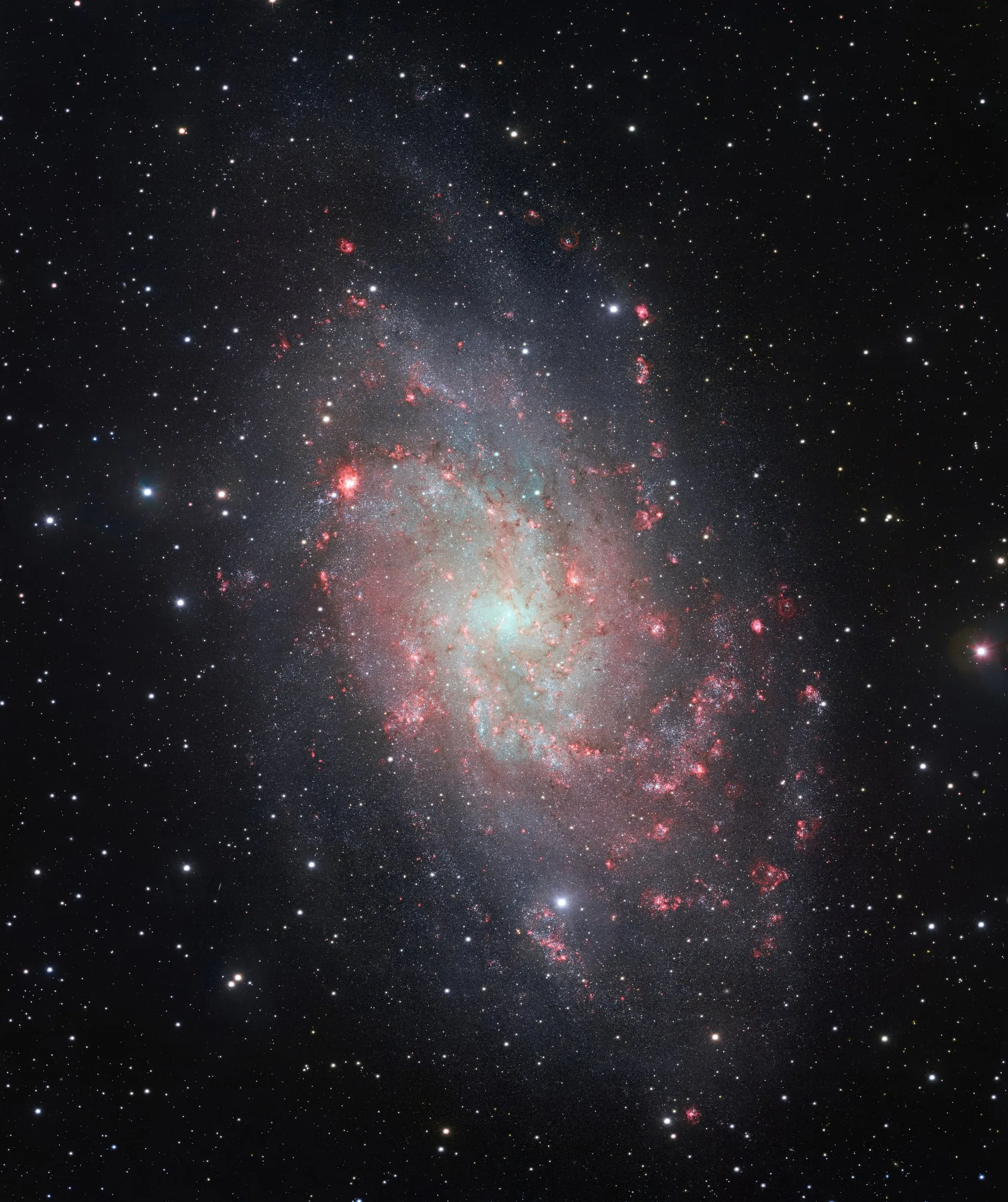
the Triangulum Galaxy (M 33) is a galaxy in the constellation of Triangulum, 62.1′ × 36.7′ across (about twice the width of the full Moon) and magnitude 5.8.
- Catalogs
- M 33 · NGC 598
- Type
- Galaxy
- Constellation
- Triangulum
- Position (J2000)
- RA 1h 33m · Dec +30° 39′
- Size
- 62.1′ × 36.7′
- Magnitude
- 5.8
- Highest it gets at 40° N
- 81°
What it emits, and which filter suits it
It has no emission lines of its own: its light comes from stars, spread across every color.
With a color camera
This is a broadband target: its light comes from stars, spread across every color. A narrowband filter would throw away almost all of its signal. What it wants is a UV/IR cut; under Bortle 5 or worse a light-pollution filter helps a little, and with a bright Moon it is better left for another night.
With a mono camera
LRGB: plenty of luminance plus the three color filters.
When to photograph it
It crosses the meridian at midnight around October. From August to December it is high for a good part of the night: early in that window it is best before dawn; by the end, it is well placed as soon as it gets dark.
- January
- February
- March
- April
- May
- June
- July
- August: good season
- September: good season
- October: good season
- November: good season
- December: good season
It culminates 81° above the horizon from latitude 40° N. Farther north it stays lower, farther south it climbs higher. With a clear horizon and away from the full Moon.
What focal length frames it well
With an APS-C sensor of 23.5 × 15.7 mm (the one in an ASI2600 or a DSLR) and three typical focal lengths:
The scale is in arcseconds per pixel, with 3.76 µm pixels.
More objects for the same season
- M 74: Phantom Galaxy · galaxy, in Pisces
- NGC 891: Silver Sliver Galaxy · galaxy, in Andromeda
- M 31: Andromeda Galaxy · galaxy, in Andromeda
- NGC 253: Sculptor Galaxy · galaxy, in Sculptor
- M 76: Little Dumbbell Nebula · planetary nebula, in Perseus
- NGC 457: Owl Cluster · open cluster, in Cassiopeia
- Sh2-185: Ghost of Cassiopeia · emission nebula, in Cassiopeia
- NGC 281: Pacman Nebula · emission nebula, in Cassiopeia