Emission nebula · Cassiopeia
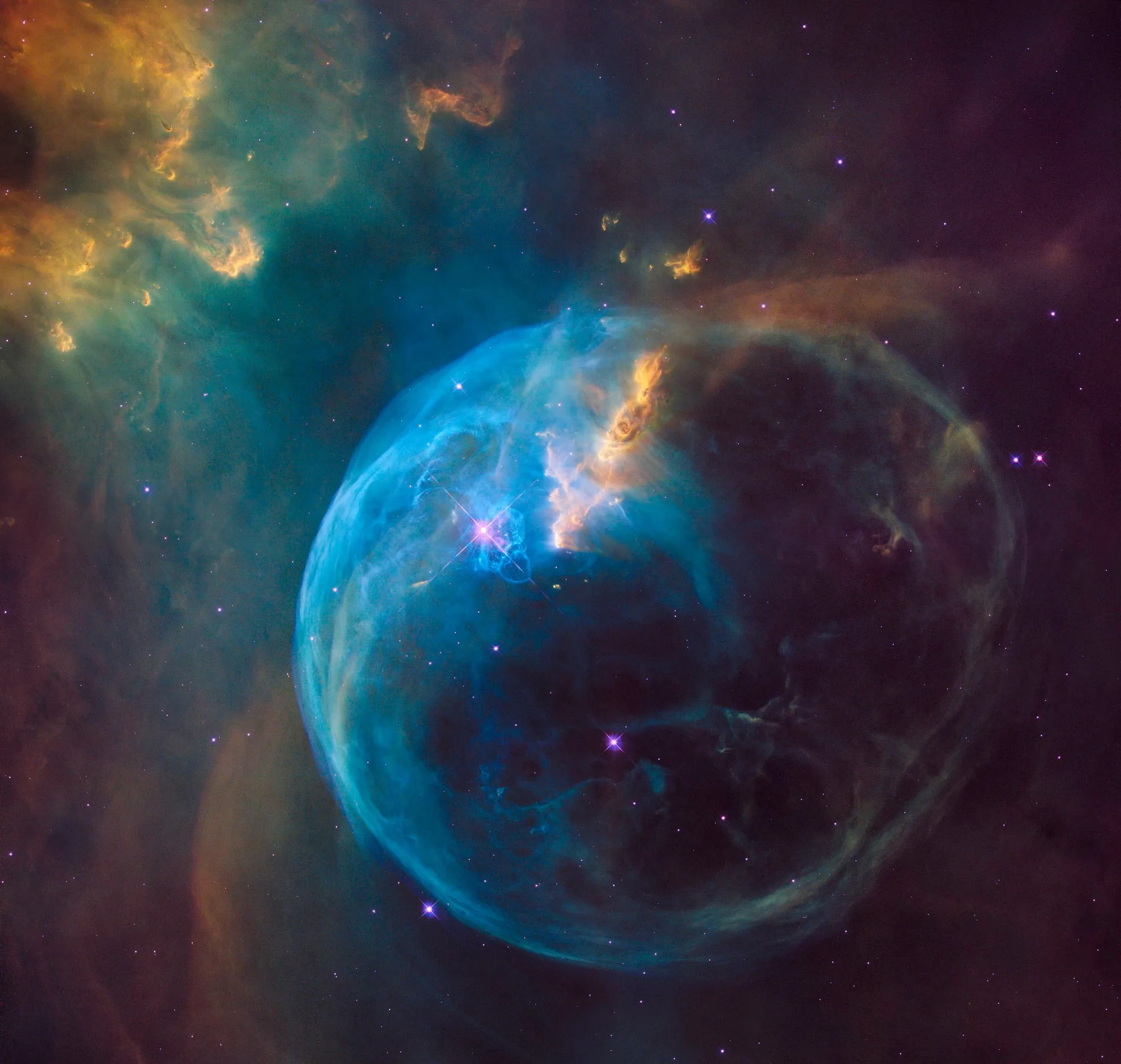
NGC 7635: Bubble Nebula
Bubble Nebula (NGC 7635) is an emission nebula in the constellation of Cassiopeia, 40′ across and magnitude 11.
- Catalogs
- NGC 7635 · C 11 · Sh2-162 · LBN 548 · LBN 549
- Type
- Emission nebula
- Constellation
- Cassiopeia
- Position (J2000)
- RA 23h 20m · Dec +61° 12′
- Size
- 40′
- Magnitude
- 11
- Highest it gets at 40° N
- 69°
What it emits, and which filter suits it
Its light is concentrated in a few emission lines: Hα (strong), OIII (strong), SII (faint).
With a color camera
With a color camera, a dual-band filter (Hα + OIII) is what helps most, especially with the Moon up or under a Bortle 5 or worse sky: it lets Hα and OIII through, which is nearly all of its light, and blocks the rest. Under a dark sky with no Moon, a UV/IR cut also works, with more natural colors and more time on target.
With a mono camera
With a mono camera, narrowband: Hα and OIII, and SII if you have the hours to spare.
When to photograph it
It crosses the meridian at midnight around September. From July to November it is high for a good part of the night: early in that stretch, before dawn; late in it, as soon as night falls. From Spain it never sets: it stays above the horizon all night, all year, although at other times of year it rides low.
- January
- February
- March
- April
- May
- June
- July: good season
- August: good season
- September: good season
- October: good season
- November: good season
- December
It culminates 69° above the horizon from latitude 40° N. Farther north it stays lower, farther south it climbs higher. With a clear horizon and away from the full Moon.
What focal length frames it well
With an APS-C sensor of 23.5 × 15.7 mm (the one in an ASI2600 or a DSLR) and three typical focal lengths:
The scale is in arcseconds per pixel, with 3.76 µm pixels.
More objects for the same season
- Sh2-157: Lobster Claw Nebula · emission nebula, in Cassiopeia
- C 9: Cave Nebula · emission nebula, in Cepheus
- NGC 7380: Wizard Nebula · cluster with nebulosity, in Cepheus
- NGC 7822 · emission nebula, in Cepheus
- NGC 7331: Deer Lick Group · galaxy, in Pegasus
- NGC 7814: Little Sombrero · galaxy, in Pegasus
- NGC 7293: Helix Nebula · planetary nebula, in Aquarius
- M 31: Andromeda Galaxy · galaxy, in Andromeda